By Warren Finkel, IT strategy expert for financial services and wealth management customers
Hybrid work is no longer temporary – it’s the default operating model for many Registered Investment Advisers (RIAs). But that flexibility comes with a tradeoff: a larger, less controlled attack surface. Client financial data now moves across home networks, personal devices, and cloud platforms, raising a critical question for regulators like the SEC: are firms still adequately protecting sensitive information? A hybrid work security checklist provides a practical framework to manage this risk across people, processes, and technology – helping identify exposure points and the controls needed to address them.
Where RIAs Are Most Exposed
Many firms assume their existing security measures are sufficient. In reality, hybrid work introduces gaps that traditional office-based setups never had to account for.
Common vulnerabilities include:
- Unsecured endpoints: Laptops and mobile devices without centralized security controls
- Unsafe networks: Employees working from home or public Wi-Fi without secure access requirements
- SaaS sprawl: Use of unapproved or unmonitored cloud applications
- Data leakage: Client information moving outside approved systems
- Phishing risk: Remote employees are more vulnerable to targeted attacks
If any of these areas feel uncertain, that’s a signal your current setup needs attention.
Essential Security Controls for Registered Investment Advisers
To close these gaps, RIAs need clear, enforceable controls – not vague policies. Use this checklist as a baseline:
Access & Identity Controls
- Mandate multi-factor authentication (MFA) across all systems
- Enforce least privilege access controls and conduct regular access reviews
Endpoint & Device Security
- Encrypt all endpoints to protect data if devices are lost or stolen
- Deploy endpoint detection and response (EDR) for real-time threat visibility
- Require secure remote access (VPN or SASE solution)
Cloud & Data Protection
- Monitor and manage SaaS application usage to reduce shadow IT risk
- Secure and regularly review configurations in platforms like Microsoft 365 security settings
- Implement data loss prevention (DLP)
Monitoring & Visibility
- Centralize security logging and audit trails for visibility and compliance
Resilience & Response
- Maintain immutable backups and test recovery processes regularly
- Establish a documented incident response plan with clear escalation procedures
User & Environmental Risk
- Standardize home network security guidelines for employees
- Conduct ongoing security awareness training
These are not advanced controls – they are foundational. And increasingly, they are what regulators expect to see in place.
Why a Checklist Isn’t Enough: The Need for Continuous Monitoring
A checklist helps you establish baseline protection. But cyber threats don’t operate on a checklist – they’re continuous, automated, and often opportunistic.
Ransomware in particular has become more targeted toward financial firms. Attackers look for weak endpoints, compromised credentials, or misconfigured cloud environments – and they don’t wait for business hours.
That’s where continuous monitoring comes in.
A managed security provider can:
- Monitor activity across endpoints, networks, and cloud platforms 24×7
- Detect unusual behavior before it becomes a breach
- Act quickly to isolate threats and prevent escalation
For example, if compromised credentials are used to access systems from an unusual location, a monitoring team can shut that down immediately – often before any damage is done.
Without that layer, most RIAs are effectively unmonitored outside business hours.
Maintaining Sustainable Security in Hybrid RIA Environments
Hybrid work has changed how RIAs operate – but it hasn’t changed the expectation to protect client data. The firms that succeed in this environment aren’t the ones with the most tools. They’re the ones with clear, enforced controls and visibility into what’s happening across their environment at all times.
A checklist is the starting point. Ongoing monitoring and strong IT management are what make it sustainable.
For many RIAs, that level of consistency and visibility is difficult to maintain internally – especially across remote users, cloud platforms, and evolving regulatory expectations. That’s where working with a managed IT and security partner can make a meaningful difference.
A strong IT partner helps by:
- Enforcing consistency across all devices, regardless of location
- Securing cloud platforms like Microsoft 365, which are often misconfigured by default
- Managing backups and recovery, ensuring you can recover quickly from an incident
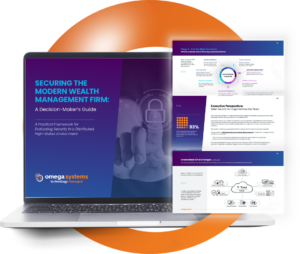 At Omega Systems, we work with financial firms navigating these exact challenges, helping implement secure hybrid access, continuous monitoring, and compliance-ready infrastructure built to hold up under scrutiny.
For a deeper look at how to evaluate secure access in a hybrid environment, download the full buyer’s guide.
📥 Access the SASE Buyer’s Guide for Wealth Management

FAQ: Hybrid Work Security for RIAs
What is the biggest cybersecurity risk in a hybrid RIA environment?
Unsecured endpoints and compromised credentials are the most common entry points for attackers, especially in remote settings.
Is MFA enough to secure client data?
No. MFA is critical, but it must be combined with endpoint protection, encryption, and monitoring.
Do RIAs need 24×7 monitoring?
In practice, yes. Threats don’t follow business hours, and most attacks happen outside of them.
How often should RIAs review their security controls?
At minimum annually – but ideally continuously, especially as hybrid work environments evolve.
 ABOUT THE AUTHOR
Warren Finkel, Managing Director of Omega’s Northeast region, brings decades of experience in IT strategy and tailored solutions for customers in family offices, RIAs, hedge funds, and other financial services sectors. Read Warren Finkel’s full executive profile here.
Connect with Warren on LinkedIn.