Updated February 12, 2026 | Reflects current CJIS Security Policy requirements, audit expectations, cloud compliance standards, and third-party oversight considerations.
Agencies that handle Criminal Justice Information (CJI) operate under some of the most stringent security requirements in government. CJIS compliance is not optional — it is mandatory for maintaining access to sensitive federal systems and protecting national security data.
What Is CJIS Compliance?
Criminal Justice Information Services (CJIS) is an FBI division that provides secure information-sharing services to law enforcement agencies at all levels of government. The CJIS ecosystem includes systems such as:
- Uniform Crime Reporting (UCR)
- National Data Exchange (N-DEx)
- Next Generation Identification (NGI)
- National Crime Information Center (NCIC)
- Law Enforcement Enterprise Portal (LEEP)
- National Instant Criminal Background Check System (NICS)
CJIS compliance enables authorized entities to access and process Criminal Justice Information (CJI), which includes highly sensitive data such as:
- Biometric records
- Biographic identifiers
- Incident history
- Identification records
The CJIS Security Policy (CSP), aligned in part with NIST 800-53 control frameworks, establishes the technical, administrative, and physical safeguards required to protect CJI. Administrative records unrelated to criminal justice investigations are not classified as CJI.
Why CJIS Compliance Matters
As agencies expand cloud adoption and digital service delivery, securing CJIS-regulated environments has become increasingly complex. Compliance ensures that sensitive investigative data is protected without compromising individual privacy rights.
Failure to comply carries significant consequences — including potential loss of access to CJI systems, audit findings, operational disruption, and reputational damage. For agencies and their service providers, audit readiness is now a continuous obligation, not a periodic event.
How CJIS Audits Work
The CJIS Audit Unit (CAU) and designated CJIS Systems Agencies (CSA) conduct formal compliance audits on a three-year cycle. Both agencies and their contracted service providers fall within scope.
Organizations are typically notified months in advance, but effective programs operate in a constant state of readiness.
During an audit, inspectors will:
- Evaluate data integrity and handling procedures
- Inspect physical security controls
- Review access management practices
- Assess policy documentation and incident response processes
Audits conclude with an exit briefing and are followed by a formal report outlining findings and remediation requirements. The CAU tracks corrective action progress, requiring documented follow-through.
Checklist for CJIS Compliance Requirements
Organizations must maintain compliance across 13 primary control domains to lawfully handle CJI. Key areas include:
- Information Exchange Agreements: Documented data-sharing protocols with defined logging, audit, and security control requirements.
- Security Awareness Training: Initial training within six months of assignment and mandatory annual refresher programs.
- Incident Response Plan (IRP): A documented plan for identifying, containing, reporting, and recovering from security incidents.
- Auditing & Accountability: Comprehensive logging of CJI access and activity.
- Access Control: Role-based restrictions limiting CJI access to authorized users only.
- Identification & Authentication: Strong credential controls and multi-factor authentication enforcement.
- Configuration Management: Controlled, documented system changes and authorized hardware/software modifications.
- Media Protection: Safeguards for digital and physical media containing CJI.
- Physical Security: Facility protections including surveillance, controlled entry, and environmental safeguards.
- Systems & Communications Protection: Encryption and integrity controls for transmitted and stored CJI.
- Formal Audit Participation: Successful completion of triennial compliance reviews.
- Personnel Security: Fingerprint-based background checks and lifecycle-based access management.
- Mobile Device Controls: Acceptable use policies and enforced safeguards for smartphones, tablets, and remote endpoints.
Maintaining these controls requires structured governance, documentation discipline, and technical enforcement mechanisms.
Third-Party & Cloud CJIS Compliance
Agencies that rely on third-party IT providers remain responsible for ensuring their partners meet CJIS standards. This includes managed service providers, cloud hosts, and data center operators.
CJIS-compliant cloud environments must enforce strict access controls, encryption standards, facility security measures, and ongoing personnel training requirements.
When evaluating an MSP or cloud provider, agencies should validate:
- Physical and logical access controls
- Encryption and network segmentation practices
- Documented security awareness training programs
- Formal audit history and corrective action processes
Third-party oversight is a critical component of maintaining defensible CJIS compliance in modern hybrid environments.
How Omega Systems Supports CJIS Compliance
CJIS compliance requires more than policy documentation — it demands secure infrastructure, audit-ready controls, and ongoing oversight. Omega Systems delivers purpose-built solutions designed to support agencies and authorized service providers operating within CJIS-regulated environments.
Our CJIS-aligned cloud infrastructure is hosted within secure private data center environments that have successfully completed CLEAN technical audits and adhere to CJIS Security Policy requirements. In addition, Omega undergoes annual SOC 2 examinations to validate the integrity, availability, and security of our hosted systems.
With decades of experience supporting local, state, and federal government entities, our team understands the operational, regulatory, and technical controls required to maintain audit readiness. Our compliance consultants assist agencies with risk assessments, control implementation, documentation review, and remediation planning to help strengthen defensible compliance posture.
Contact our team to discuss how Omega Systems can support your CJIS compliance strategy and strengthen your secure infrastructure foundation.
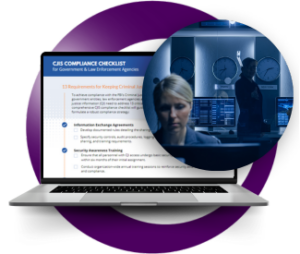 Download the CJIS Compliance Checklist
Access a structured, audit-ready checklist outlining the 13 core CJIS Security Policy control domains required for handling Criminal Justice Information (CJI). Designed for local, state, and federal agencies, this resource helps organize your compliance strategy and strengthen audit preparedness.